EXPLORE LUNA'S ARCHITECTURE

LUNA is not one AI model.

LUNA Core is a running experimental software system, not solely a proposed architecture or white paper. This page describes both the architecture operating today and the accepted architecture being developed around it. Every subsystem is marked by its current implementation status.

Private implementation, public architecture: the source code and live runtime are not exposed here. The map is a reviewed public view of the real system and its continuing development; it is not a live connection to LUNA.

CURRENT RUNTIME · SEPTEMBER 2026

Where the running system sits today.

Current Runtime is a live slice through the architecture below—not a separate, smaller architecture. Status labels distinguish what functions today, what is being expanded or tested, and what has not yet been implemented.

11
Working
27
Working + Growing
8
Experimental
0
Architectural
  • 46 reviewed public subsystems in the current architecture map
  • 59 reviewed public relationships between those systems
  • Persistent continuity, memory, cognition, tools, and interaction paths operate inside LUNA Core today

SEE THE SYSTEM

Architecture overview

Select a region to see how it connects to the surrounding architecture.

Memory

How experience is kept, recalled, and made useful across time.

4 subsystems · 3 incoming / 11 outgoing cross-family relationships

Working Memory · Recent Experience · Recent-Life Horizon · Long-Term Memory

Explore these systems

Cognition

How information, goals, and possibilities become useful in the current moment.

13 subsystems · 18 incoming / 6 outgoing cross-family relationships

Foreground Cognition · Cognitive Activation Field · Cognitive Scheduler · Inference Fabric · + 9 more systems in the full explorer

Explore these systems

Background Cognition

Work that can continue around a conversation without taking attention away from the person LUNA is talking with.

9 subsystems · 2 incoming / 5 outgoing cross-family relationships

Memory Formation · Reflection · + 7 more systems in the full explorer

Explore these systems

Evaluation

How events, relationships, and LUNA's current condition can shape later judgments.

9 subsystems · 6 incoming / 5 outgoing cross-family relationships

Appraisal · Adaptive Dispositions · + 7 more systems in the full explorer

Explore these systems

Perception

How LUNA makes sense of messages and changes in her surroundings.

2 subsystems · 2 incoming / 3 outgoing cross-family relationships

Foreground Input · Perceptual Continuity

Explore these systems

Interfaces

How people interact with LUNA and receive its responses.

3 subsystems · 2 incoming / 3 outgoing cross-family relationships

Workbench · Expression · Realtime Conversation

Explore these systems

Inference

Where requests to AI language models connect with the rest of LUNA.

2 subsystems · 2 incoming / 2 outgoing cross-family relationships

Cloud AI Provider (ORBIT) · Local AI Provider (LANDED)

Explore these systems

Infrastructure

Shared support for the architecture, experiments, observation, and continuity over time.

4 subsystems · 2 incoming / 2 outgoing cross-family relationships

Turn Observation · Development Awareness · ChronoForge · + 1 more systems in the full explorer

Explore these systems
LUNA's interacting architectural families Cognition sits near the center. Model providers occupy the bounded Inference region at the right. Ribbons represent public connections; thicker ribbons contain more subsystem relationships. Family details update in the adjacent selection panel.

Persistent cognition is a systems problem.

LUNA is not one model and not one memory database. It is an attempt to build interacting cognitive infrastructure around inference so that history can remain causally relevant over time.

Capability boundary: this page describes the accepted research architecture at a public level. Current maturity is described as Working, Working + Growing, Experimental, or Architectural. A design document is never treated as proof of an active capability.

THE LONGITUDINAL LOOP

From event to consequence to a different future.

The central idea is simple: a present event should be able to leave effects that alter how a later event is perceived, remembered, valued, or acted on.

World / inputUser interaction, tools, internal cognition, and eventually continuous sensory events.
AppraisalWhat changed? How relevant, expected, consequential, controllable, or self-related is it?
ActivationWhich memories, intentions, questions, or cognitive products become near the surface?
Choice / actionForeground reasoning, contemplation, planning, speech, tools, waiting, or other action.
ConsequenceOutcome, feedback, changed world state, and evidence that can affect what happens next.
ContinuityPersistent autobiographical state and provenance connect the loop across time.
DevelopmentSome consequences may alter slower structures instead of surviving only as recallable episodes.
ProspectionFuture events and unresolved commitments can remain active beyond the current interaction.
Compute disciplineLightweight state and scheduling stay cheap; expensive inference is invoked only when cognition justifies it.

PUBLIC ARCHITECTURE

Explore the full architecture.

46 subsystems 59 relationships 8 architectural families

Showing all 46 subsystems. Select one to inspect its role.
AI model inference happens here The surrounding architecture handles memory, continuity, evaluation, motivation, current conditions, scheduling, history tracking, and other supporting work.
Interactive public map of LUNA's architecture 46 public subsystems grouped into 8 architectural families. The inference providers occupy one highlighted region inside the larger architecture. Foreground Input Workbench Expression Working Memory Recent Experience Recent-Life Horizon Foreground Cognition Cognitive ActivationField Reverie Cognitive Products Contemplation Cognitive Scheduler Prospective Cognition Goal and Task State Volition andMotivational Dynamics Inference Fabric Cloud AI Provider(ORBIT) Local AI Provider(LANDED) Long-Term Memory Memory Formation Reflection Appraisal Adaptive Dispositions Relationship State HomeostaticModulation Actor Attribution Expression Grounding Turn Observation Development Awareness ChronoForge Perceptual Continuity Background MemoryCoordination Manual Sleep Sleep Pattern Review Waking Residue Wake Transition Wake AutobiographicalConsequence Automatic Sleep Architecture Observer Realtime Conversation DevelopmentalPlasticity Read-Only ActionBoundary Volitional Commitment Epistemic Initiative Learned MethodValuation Prospective Motives

Drag to pan. Use the visible controls or a wheel/trackpad to zoom.

ACCESSIBLE DIRECTORY

Choose a subsystem by name.

HOW TO READ THE MAP

Architecture first. Maturity second.

Family color groups systems by their primary architectural role.

Relationships show only the reviewed public connections between systems.

Maturity describes present development scope, not importance or quality.

The dashed inference region shows where AI model requests connect to the larger architecture.

PUBLIC MATURITY

These labels describe development scope, not quality.

WORKING

Functioning today.

WORKING + GROWING

Already works today and is still being expanded.

EXPERIMENTAL

A real implementation being used for controlled research or testing.

ARCHITECTURAL

Part of LUNA's architecture but not currently implemented.

MAJOR RESEARCH SYSTEMS

The architecture is deliberately modular.

Each mechanism owns a different causal role. The goal is not to ask a language model to narrate these processes, but to give them persistent state and explicit architectural boundaries where possible.

Memory & continuity

Autobiographical history, provenance, salience, relationships, and continuity are treated as persistent system state rather than a transcript pasted into the next prompt.

Cognitive activation

Relevant memories, goals, intentions, appraisals, and cognitive products compete for limited access to the foreground.

Associative cognition

A memory or completed thought can itself become a cue, allowing cognition to make other cognition more available without requiring a new external prompt.

Appraisal & homeostasis

Events can alter short- and middle-timescale operating conditions so later cognition occurs in a state shaped by what happened before.

Developmental plasticity

The architecture separates remembering an event from the slower structural changes that consequential experience may leave behind.

Prospective cognition

Expected events, unresolved threads, intentions, deadlines, and future opportunities can persist beyond the turn that created them.

Perception & world continuity

Continuous sensors are intended to update a persistent world model in which stable conditions become quiet and violated expectations become meaningful.

Volition & motivational dynamics

Requests, goals, preferences, commitments, consequences, and competing reasons can participate in action selection rather than collapsing directly into behavior.

Architectural self-model

LUNA is designed to distinguish what the project intends, what the current runtime can actually do, and what remains unresolved.

ChronoForge

Controlled timelines let researchers manipulate developmental conditions, then compare the histories that emerge: checkpoint, branch, live through consequences, compare, and return.

PROGRESSIVE RECALL

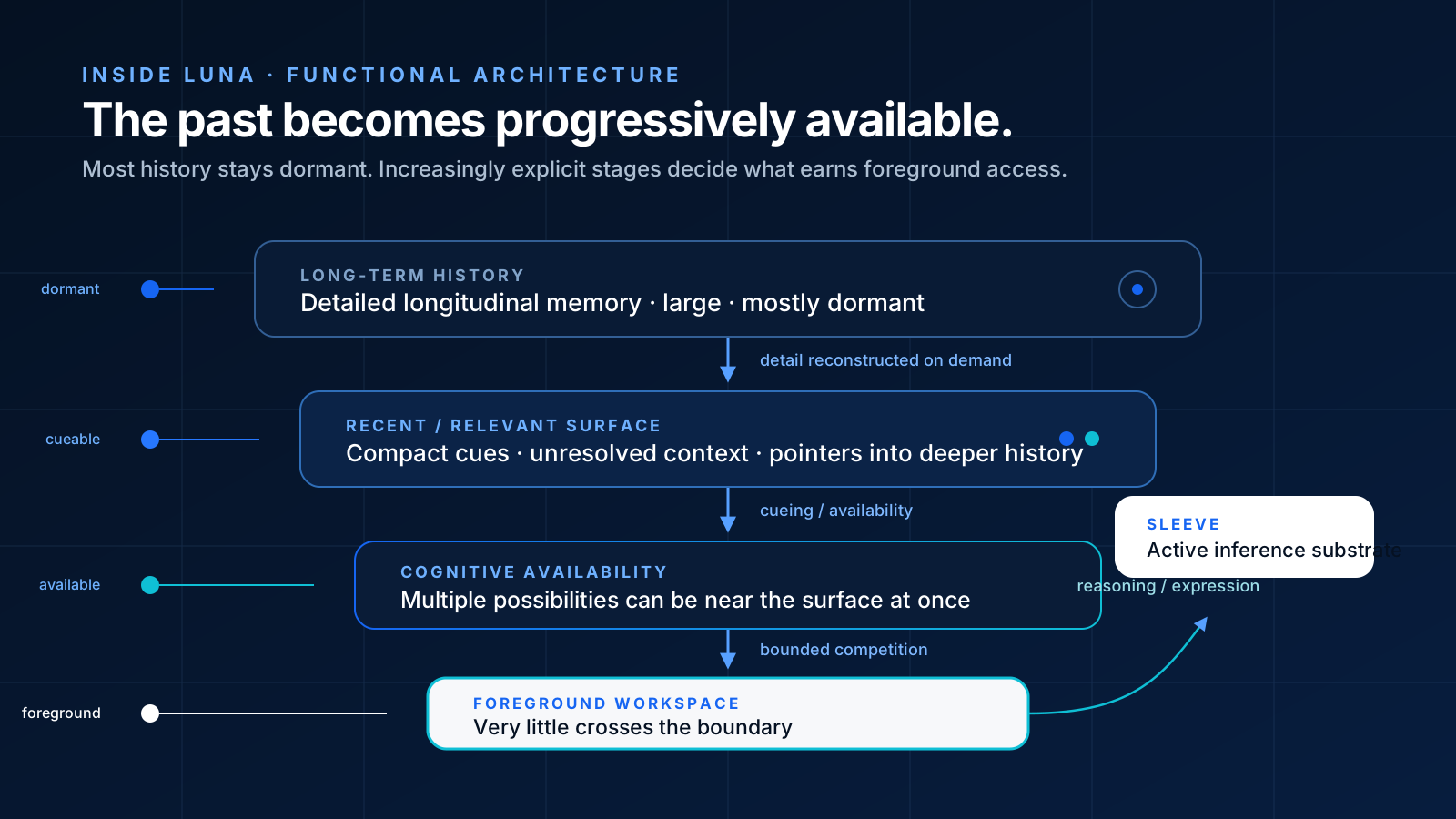
The past becomes progressively available.

LUNA separates long-term storage from current cognitive availability. Detailed history can remain dormant, compact cues can keep selected recent or unresolved material easy to reach, multiple candidates can become near the surface, and only a very small amount crosses into foreground reasoning.

Public progressive recall architecture showing long-term history, recent and relevant surface, cognitive availability, a bounded foreground workspace, and Sleeve reasoning.

Stack-side cognition

Persistent memory, recent-life cueing, activation, bounded competition, and selected admission can shape what reaches inference. The Stack is therefore more than passive storage around a model.

Sleeve-side inference

The active model reasons over the resulting foreground state. It does not need to own the entire persistent memory system or make every cognitive-state decision itself.

Current capability cutaway: persistent memory and the Recent-Life Horizon are Working. Cognitive Activation and Reverie are Working + Growing; their implemented paths remain bounded rather than claiming a finished theory of cognition. The implemented Reverie workspace path can contribute zero or one eligible internally propagated memory to the foreground without a language-model call deciding admission.

ONE OF THE CORE DISTINCTIONS

Retrieval is not development.

A system may perfectly preserve an experience and still remain behaviorally identical to a version that never had it. LUNA treats storage, retrieval, causal use, and developmental integration as different measurements.

Storage

Did the event enter durable autobiographical history?

Retrieval

Can the event or its meaning become available again when relevant?

Causal use

Did available history actually alter current reasoning, attention, creation, or choice?

Development

Can consequences remain active even when the original episode is not consciously retrieved?

STACK & SLEEVE

Continuity is intended to survive the model.

LUNA uses a simple conceptual separation. The Stack is the persistent identity-and-continuity state: autobiographical history, durable dispositions, goals, relationships, intentions, provenance, and other longitudinal state. The Sleeve is the active computational substrate through which that state currently runs.

The research objective is that changing provider, model, machine, or embodiment should not require recreating the persistent instance from a prompt. The inference model is therefore important, but it is not intended to be the whole identity of the system.

Realtime Conversation is one deliberately configured Sleeve path; it remains inside the same conversation, memory, provenance, and tool boundaries rather than creating a separate assistant.

The Sleeve can change. The Stack persists.

Architecture before theatrical behavior.

LUNA does not treat a model saying “I remember,” “I want,” or “I changed” as proof that the corresponding architecture exists. Claims about memory, motivation, self-modeling, or development are separated from fluent self-description and should ultimately be traceable to system state, history, and controlled experiments.

That is why public material distinguishes implemented behavior, accepted architecture, observation, interpretation, and prediction rather than blending them into one marketing claim.