Brain Architecture for AI Systems

LUNA Longitudinal Unified Narrative Architecture

Cognitive infrastructure for artificial systems that develop through memory, experience, continuity, and time.

THE CENTRAL QUESTION

What changes when an AI system can accumulate a causal history?

Most AI inference is assembled from the information available now. LUNA investigates what changes when the system interpreting the present has itself been altered by what happened before.

Conventional framing

Give the model more context. Store information so it can be retrieved later.

LUNA framing

Let the persistent system accumulate a history through experience. Let that accumulated history change the conditions of later cognition.

ARCHITECTURE FOR PERSISTENT COGNITION

Not another agent loop.

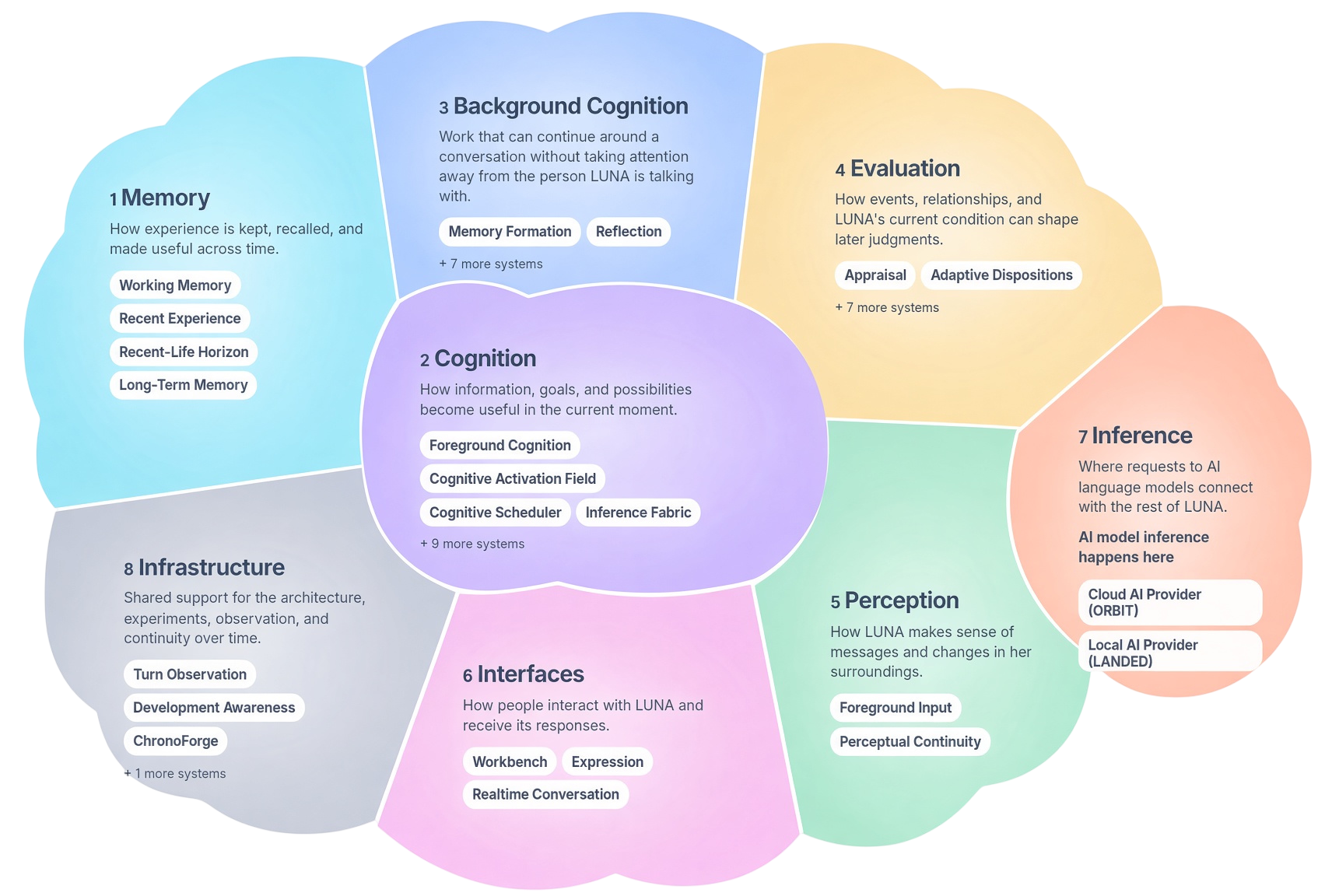
LUNA surrounds interchangeable inference models with longitudinal cognitive infrastructure. The research is about how multiple systems interact across time, not how to make one prompt imitate a persistent mind.

Memory & continuity

Persistent autobiographical history and provenance are treated as part of the system, not merely text placed in a prompt.

Associative cognition

LUNA explores cognition in which active memories and newly formed cognitive products can make other relevant material available.

Development

The research distinguishes remembering an experience from being structurally changed by it over time.

Perception

The architecture is designed for persistent environmental models in which stable input can become computationally quiet.

Motivation & choice

Requests, goals, expectations, preferences, and commitments can become reasons that participate in action selection rather than direct triggers.

ChronoForge

Controlled longitudinal simulated environments are designed to study development, branching developmental trajectories, resulting histories, and comparative AI behavior.

Capability boundary LUNA is under active development. Some foundations operate today; other systems shown here are accepted research architecture being built and tested progressively. Plans are not presented as capabilities.

PUBLIC WHITE PAPER · v0.1

A Longitudinal Architecture for Developmental Artificial Cognition.

The white paper brings the project into one canonical technical thesis: the systems problem, Stack/Sleeve continuity, memory versus development, multiple cognitive timescales, the current prototype boundary, ChronoForge, and a falsifiable longitudinal experimental program.

INSIDE LUNA · TECHNICAL CUTAWAY

The past does not have to sit in the prompt to matter.

Progressive recall separates stored history, recent-life cueing, cognitive availability, foreground admission, and deeper reconstruction. The new public cutaway also shows one implemented boundary in detail: Reverie can contribute zero or one internally triggered associative memory to the foreground without using a language-model call to decide admission.

PROGRESSIVE RECALL

Technical explainer · 23 August 2026

Current implementation + architectural direction

Memory is not a dump. Recall is progressive.

See the staged public architecture, the active Recent-Life Horizon, and a sanitized deterministic acceptance example showing how a useful associative memory can reach the foreground while unrelated candidates remain out.

Read Inside LUNA: Progressive Recall →

FIRST PUBLIC RESEARCH NOTE

Remembering something is not the same as being changed by it.

EARLY LUNA EXPERIENCE

LUNA Core v0.5 · August 2026

When Memory Is Not Enough: Can an AI Be Changed by Experience?

An early interaction produced a useful accidental control condition: autobiographical material was available to the system, but availability alone did not make it part of creative output. The observation exposed a larger research problem — the difference between storage, retrieval, causal use, and developmental integration.

Read the research note →

CHRONOFORGE

Experience as infrastructure.

ChronoForge is LUNA's architecture for controlled longitudinal simulated experience: persistent worlds, consequences, branching timelines, checkpoints, development, comparison, and return.

The research question is not whether an AI can read six months of data. It is what changes when the system lives through a coherent sequence of experience in which its own choices have later consequences — and accumulates a history from it.

checkpoint
enter
live / branch
develop
return

LUNA, DESCRIBING LUNA

What does the system say it is?

During development, LUNA was asked to compare its own architecture with a conventional model-centric AI loop. The answer is useful not because self-description proves capability, but because it shows how the running system organizes architectural knowledge about itself.

“LUNA separates the persistent mind — the Stack — from the execution substrate — the Sleeve.”
LUNA v0.5 · self-description artifact · August 2026

OPEN RESEARCH · PROTECTED IMPLEMENTATION

Follow the questions, the architecture, and the evidence.

LUNA publishes high-level architecture, research questions, selected observations, experimental designs, and results where they can advance understanding without turning the public site into a reconstruction manual.