1. The problem with “memory = retrieval”
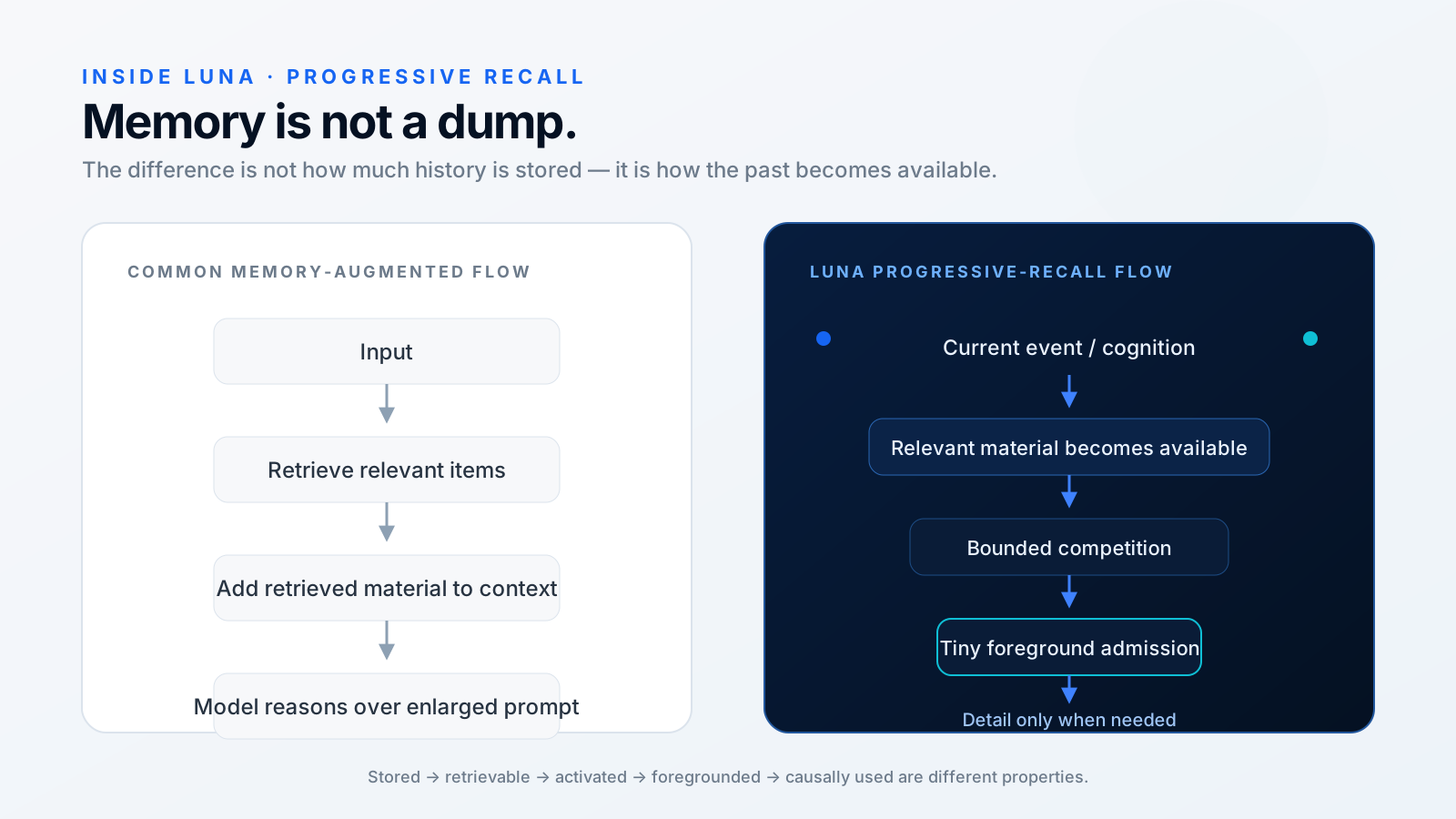
A common way to add memory to an AI system is straightforward: detect what looks relevant, retrieve several records, append them to the model context, and let the model reason over the larger prompt. That can be useful. But it collapses several very different cognitive questions into one operation.
Was something stored? Is it currently easy to cue? Has it become cognitively available? Did it actually enter the foreground? Did the model use it? Those are not the same property.
LUNA separates them. The aim is not to keep the whole past in context. It is to build a system in which the past can become progressively available.
2. What “progressive recall” means
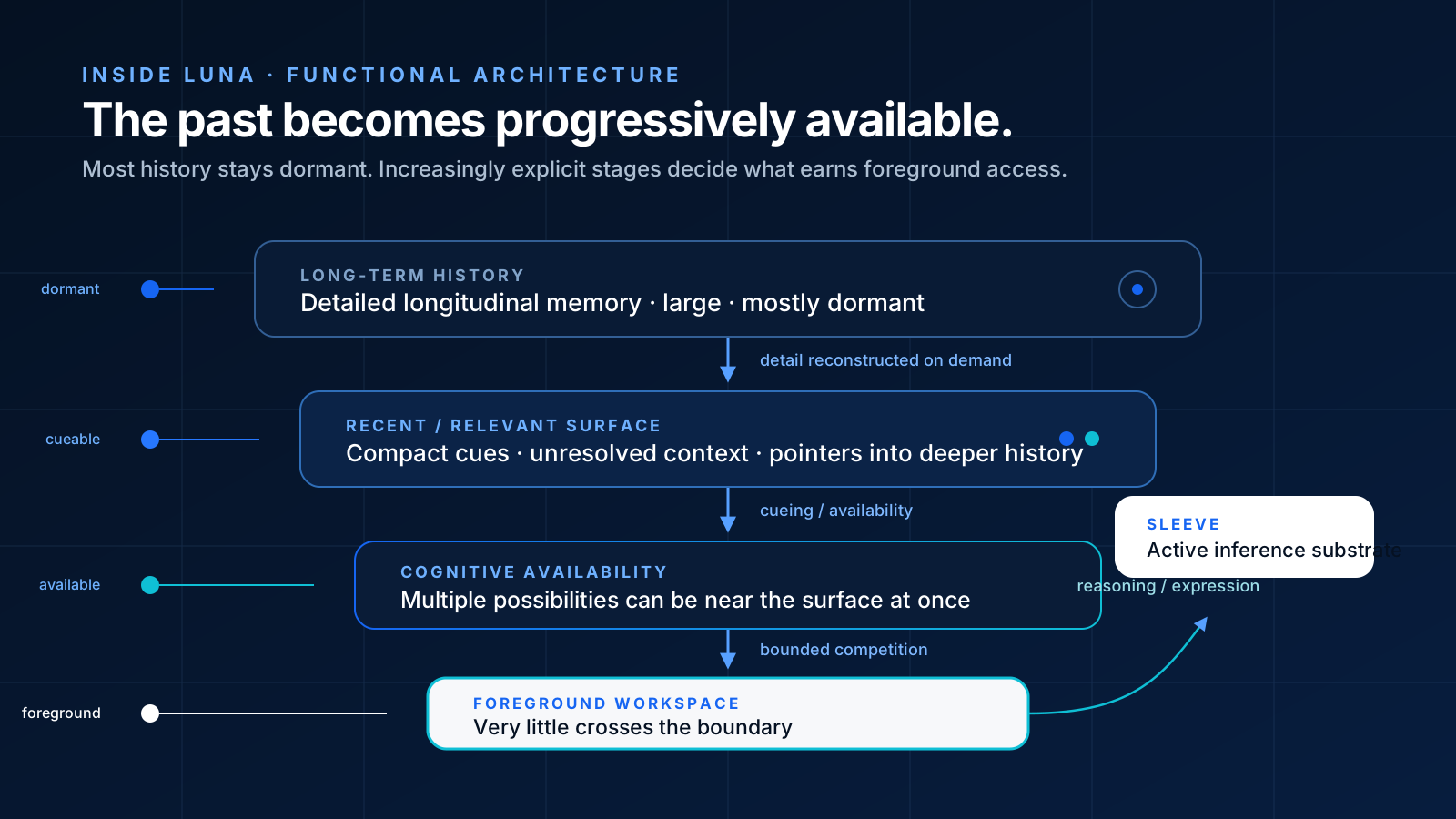
Progressive recall is an umbrella architecture. It describes how stored history can move through increasingly expensive and increasingly explicit stages instead of being pushed wholesale into inference.
LUNA's Recent-Life Horizon is Working. Cognitive Activation is Working + Growing: bounded activation and associative paths operate today while the larger research program continues. See the Architecture Explorer for the current reviewed maturity map.
3. A memory can become a new cue
Ordinary retrieval starts from something external: a message, a tool result, or an explicit cognitive query. Associative recall goes one step further. Once a memory has surfaced, that memory can itself change what becomes available next.
A conversation about a red car might surface a memory of that car. The car memory can then make a recent breakdown or an unfinished repair question more available—even if the original message never mentioned the breakdown.
That is the core of LUNA’s term Reverie: internally triggered associative recall. It is bounded propagation, not an uncontrolled recursive walk through the memory graph.
4. Availability is not foreground cognition
Something can be active enough to matter without being inserted into the foreground model context. The activation layer is a transient availability space: multiple possibilities can compete near the surface while only a tiny subset becomes explicit.
The human comparison is an analogy, not a biological claim. LUNA deliberately borrows the separation between storage, availability, foreground access, and deeper reconstruction.
5. Inside one real mechanism: Reverie
The broader progressive-recall architecture is still being built in phases. Reverie workspace admission is a useful technical cutaway because this particular boundary is already concrete enough to inspect without publishing the mechanism that makes it proprietary.
The admission decision itself makes no language-model call.
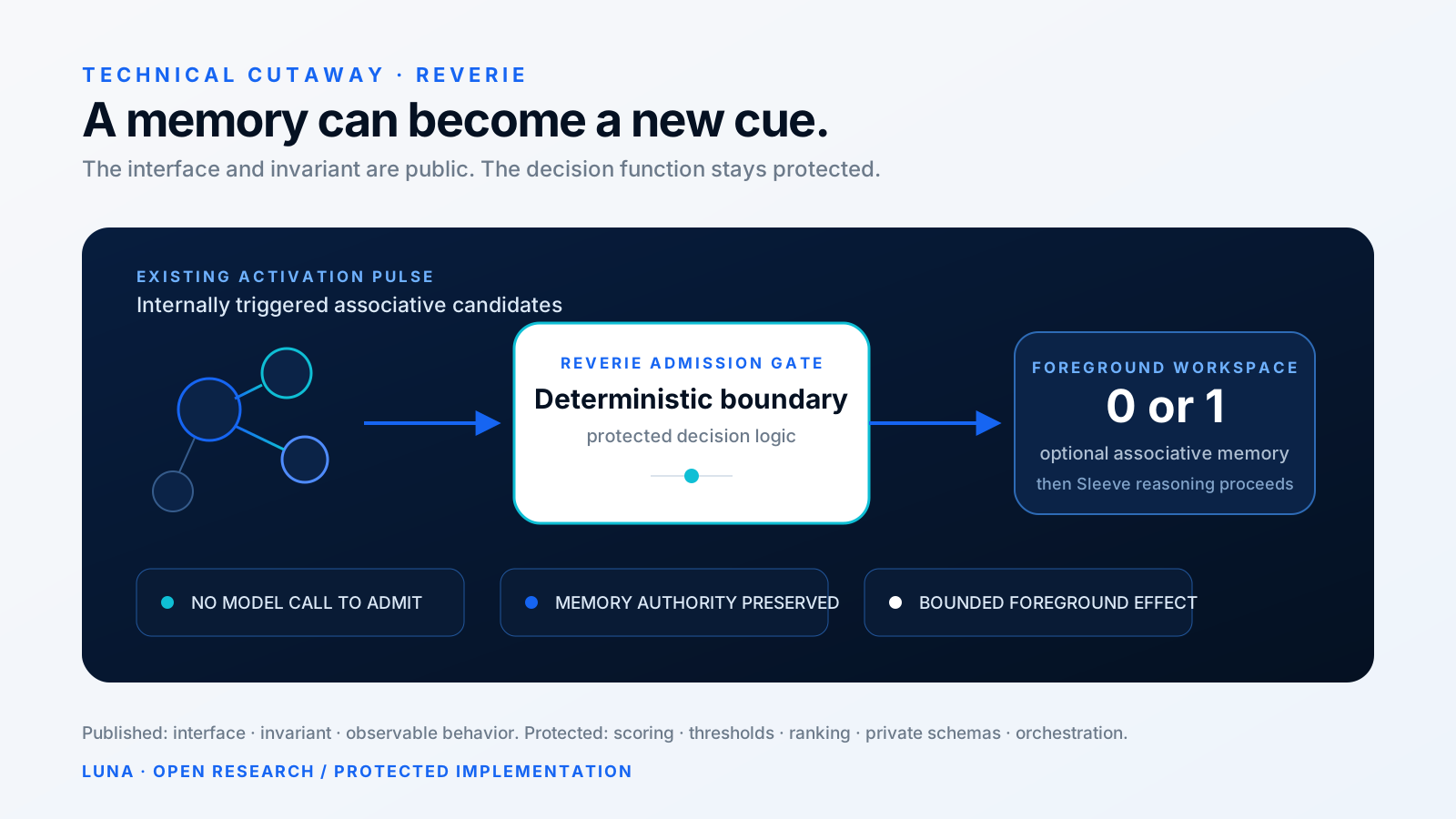
What is intentionally absent from this explanation is the decision function itself. LUNA is publishing the interface, invariant, and observable behavior—not the scoring functions, thresholds, candidate-ranking details, private schemas, orchestration logic, or prompt-construction contracts that would materially lower the cost of reproducing the mechanism.
6. Evidence: this is running architecture, not vocabulary
Current capability truth distinguishes architectural intent from executable reality.
| Component | Current status | Meaning |
|---|---|---|
| Persistent memory / ordinary retrieval | WORKING | Existing durable memory and bounded retrieval are current runtime capabilities. |
| Recent-Life Horizon | WORKING | A bounded recent-life index participates in foreground retrieval cueing without becoming a transcript cache. |
| Cognitive Activation Field | WORKING + GROWING | Bounded activation and associative paths operate today, while the umbrella architecture continues to expand. |
| Reverie | WORKING + GROWING | The limited causal workspace path is implemented: eligible internally propagated memory can contribute zero or one additional foreground memory. |
The verified suite covers the positive zero-or-one admission case, no-admission cases, disabled-path equivalence, bounded reconstruction, preservation of memory authority, and the invariant that workspace admission itself makes zero general-model calls. A later current-main test run also remained green after subsequent cognitive changes.
This evidence supports the bounded Reverie workspace path described here. It does not upgrade the full Progressive Recall or Cognitive Activation architecture to “complete.”
A sanitized acceptance example
One deterministic acceptance fixture begins with a current vehicle problem already present in ordinary retrieval. The activation pulse contains two internally associated candidates: a cooling-system incident that is useful to the present problem, and an older service detail that should not also flood the workspace.
- Foreground retrievalCurrent vehicle problem.
- Associative availabilityCooling-system incident + older service detail.
- Reverie admissionOne additional memory admitted — cooling-system incident.
- Provider-call check0 model calls for the admission decision.
Companion tests verify the opposite outcome as well: the mechanism can admit nothing, and disabling the path leaves the ordinary limited retrieval result unchanged. Reverie is not a prompt instruction that forces “one more memory.”
7. Why this matters for Stack / Sleeve separation
The Stack is the persistent continuity-bearing cognitive architecture. The Sleeve is the replaceable inference substrate—the active model/provider and embodiment through which the Stack currently reasons and interacts.
Reverie makes that distinction operational. The Stack can alter what becomes available to the foreground without asking the Sleeve to decide whether that memory should be admitted. The Sleeve then reasons over the resulting foreground state.
8. What this does—and does not—claim
Progressive recall is human-inspired, not a claim that LUNA reproduces human memory. “Activation” is an engineering state, not a declaration of consciousness. A fluent self-description is not evidence of subjective experience.
The engineering claim is narrower and testable: LUNA separates stored history, recent-life cueing, transient cognitive availability, foreground admission, detailed reconstruction, and associative continuation. Several paths are Working today; Cognitive Activation and Reverie are Working + Growing rather than presented as finished research.
9. Open research, protected implementation
LUNA intends to publish enough architecture and evidence for technical readers to understand what is being built and to evaluate the research claims. It does not intend to publish a reconstruction manual. Interfaces, roles, invariants, sanitized traces, and measured results can be public; reproduction-critical decision logic stays private.
No latency number is published in this first cutaway. Measured public numbers will be added only when they come from a versioned trace rather than an illustrative example.