WHAT IS LUNA?
A persistent architecture around inference.
LUNA is a longitudinal cognitive architecture exploring what happens when artificial intelligence is given persistent memory, developmental experience, continuity, and time.
Foundation models are extraordinarily capable inference systems. But an inference response is normally assembled from the state available at that moment: learned weights, current context, retrieved information, tool results, and whatever surrounding software has supplied.
LUNA investigates a different systems question: what happens when the inference model operates inside a persistent cognitive architecture whose own history can alter the conditions of later cognition?
Context vs. causal history
Context
“Here is information about what happened before.” The past is supplied to the current inference episode.
Causal history
“What happened before changed the system receiving this information.” The history can alter future retrieval, expectation, motivation, attention, or choice.
Causal history, not just context.
A persistent system can preserve autobiographical episodes, maintain continuity across interactions, carry unresolved intentions forward, form expectations, and accumulate slower state. LUNA explores how those mechanisms can interact so that two otherwise similar systems may eventually behave differently because they lived through different experiences and therefore accumulated different histories.
A familiar target, without turning the analogy into a claim.
People do not experience every interaction as if it were the first. Prior encounters change what is easy to recognize, what feels relevant, what can be inferred safely, and what still needs evidence. LUNA is interested in the systems equivalent of that continuity: not human memory or human emotion, but a persistent architecture in which previous interactions can alter the informational conditions of later cognition.
Actor Attribution can resolve the current person without requiring their name to appear as a lexical retrieval cue.
A fact can exist in persistent memory without being retrieved or entering the current foreground.
Later evidence can change the epistemic status of an earlier interpretation without rewriting what happened before.
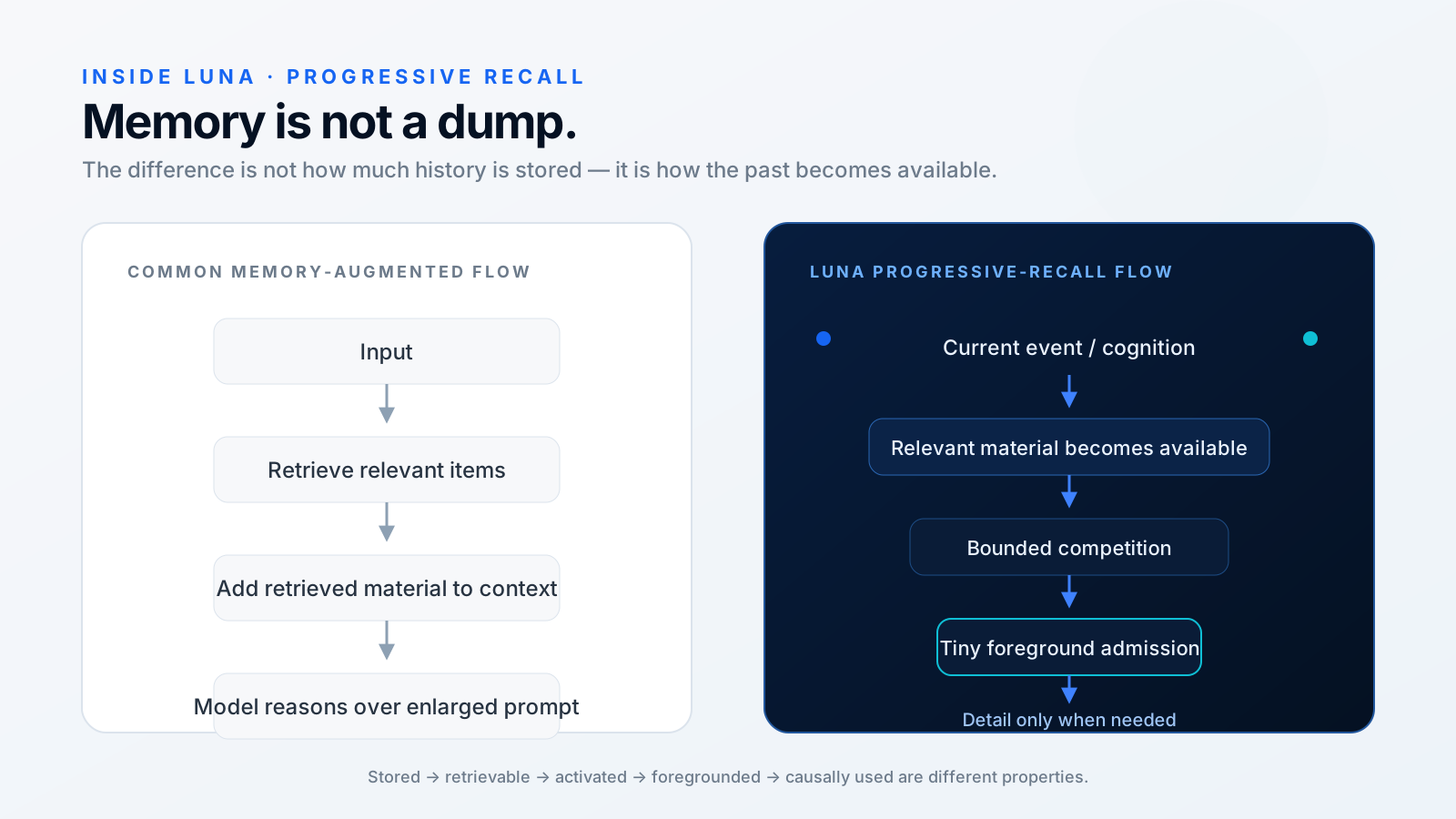
Memory is not a dump. Recall is progressive.
LUNA does not treat every relevant memory as material that should immediately be pasted into the next model prompt. Progressive recall separates stored history, recent-life cueing, cognitive availability, foreground access, and deeper reconstruction.
That distinction creates a place for information to become “near the surface” without automatically becoming foreground model context. A surfaced memory can also become a new cue, making related history more available. LUNA calls that internally triggered associative recall Reverie.
Knowledge, experience, development
A simple stove example captures one of the project's central distinctions. Being told that a stove can burn you and being burned by the stove can produce the same propositional knowledge while producing very different later behavior.
The developmental question is whether consequential experience can alter prediction, attention, aversion, confidence, association, or action valuation even when the source episode is not explicitly reconstructed every time.
Knowledge
The system can state what is true or what usually happens.
Experience
The running instance acts, encounters a consequence, and preserves that event as part of its own history.
Development
The consequences of that history alter later cognition or behavior in a stable, provenance-backed way.
Revision
Later evidence can weaken, narrow, or reinterpret what earlier experience caused without rewriting history.
Architecture before performance.
LUNA does not attempt to create mind-like behavior by placing a large identity script in front of a language model. It already has working memory, continuity, goal, interaction, formation, and recent-life infrastructure. Other systems are functional but still expanding, while several remain controlled research mechanisms or architectural direction. The Architecture Explorer carries the reviewed current maturity picture instead of asking this conceptual overview to flatten those differences.
Realtime Conversation is Experimental. A realtime conversational Sleeve is implemented and can support live speech while remaining inside LUNA's existing conversation, memory, and tool boundaries. It is deliberately configured and disabled by default.
The Stack and the Sleeve
LUNA separates persistent continuity from the substrate currently performing inference. The Stack is the continuity-bearing state: autobiographical history, persistent identity and self-model state, durable goals, dispositions, relationships, intentions, and provenance. The Sleeve is the replaceable computational substrate through which that Stack is currently instantiated.
The design objective is that changing model, provider, machine, interface, or eventual embodiment should not require reconstructing the same LUNA instance from a prompt.
Not one foundation model.
The inference substrate is conceptually separable from the persistent architecture around it. LUNA treats model inference as an important cognitive resource, but not as the implementation language of every subsystem and not as the sole definition of persistent identity.
Lightweight state, scheduling, time, graph operations, prospective triggers, and control logic can remain active without a large model continuously resident. High-capability inference can be requested when a cognitive operation actually needs it.
What LUNA is not.
- Not merely a chatbot wrapper.
- Not merely a memory plugin.
- Not merely an autonomous-agent framework.
- Not a consciousness module.
- Not evidence that current artificial systems are phenomenally conscious.
- Not a claim that every mechanism described by the research architecture is already implemented.
- Not one particular foundation model or provider.
The research stance.
LUNA distinguishes implemented behavior, accepted architecture, observation, interpretation, and prediction. That boundary matters especially when the subject is persistent artificial cognition, where fluent self-description can easily be mistaken for stronger evidence than it actually provides.
The project is therefore intentionally open about its questions and selected observations, while keeping implementation details private where publication would mainly lower the cost of reproducing the system rather than improve understanding.